All articles · 2026-09-18
Paisley and floral motifs: one drawing, printed, cut and projected
A hand-drawn motif ends up on backdrops, stencils, menu cards and cut panels. Line art mode turns the scan into geometry that scales to all of them.
Decor motifs almost always start by hand — drawn on paper, photographed on a phone, sent on WhatsApp, and then asked to appear on a three-metre backdrop, a stencil, a menu card and a laser-cut screen. Each of those needs a different size and a different process, and none of them can use the photograph.
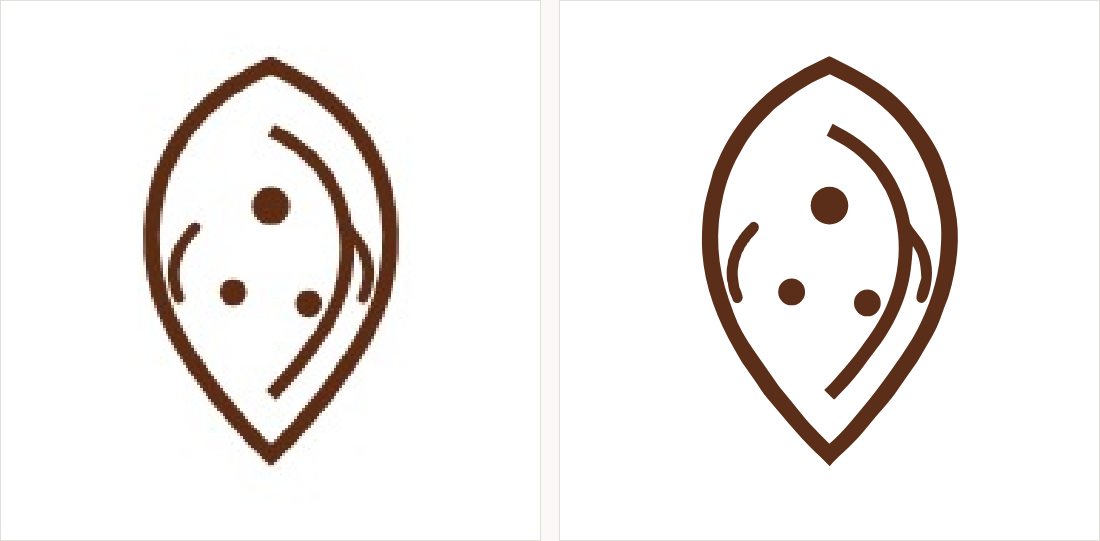
Line art mode, not Logo mode
A motif made of strokes is a different problem from a badge made of filled areas. Line art mode follows the ink rather than treating every enclosed region as a shape to fill, which is what keeps the inner curls of a paisley as curls instead of as flat blobs. Set the colour count to two — ink and paper — for a pen drawing.
Photograph it properly and the trace gets easier
Most of the quality of a traced motif is decided before the trace. Flat, even light with no shadow across the page; the camera square to the paper rather than at an angle; and the largest photo your phone will take, sent as a file rather than through a chat app that recompresses it. Ten seconds of care here removes most of the cleanup afterwards.

Where a stencil differs from a print
A printed motif can contain floating pieces — a dot inside a curl is simply printed. A cut stencil cannot: anything not connected to the rest of the material falls out. If the motif is destined to be cut, every island needs a bridge to its neighbour, and that is a decision about the design, made by a person, before the file goes to the machine.
Scaling honestly
- Trace once, at the best quality you can get, then use that one file everywhere
- For a large backdrop, check the stroke weight at final size — a delicate line at A4 becomes a thick band at three metres
- For a small menu card, the opposite: fine inner detail closes up and is better removed than shrunk
- Keep the traced original untouched and make size-specific copies from it
The one thing tracing cannot do is finish a drawing. Where two strokes have already run together in the photograph, the vector will show them run together — cleanly, evenly, and still joined. That is a re-draw, not a re-trace.